
Gramicci is now a fashion fixture in everyday life, but its roots are clearly in climbing. The brand originated from the climbing pants of legendary rock climber Mike Graham, who was dubbed the "Stone Master" in the 1970s. In this series of articles, we will explore the mentality and lifestyle of climbers who have been captivated by the sport, and how they approach climbing. The signpost that traces the origin of Gramicci once again embodies the essence of surviving in the present.


NAME
Takeshi Ito
TITLE
Botanix Representative/Route Setter
AREA
LOKU BOKU
PROFILE
Born in 1979 in Nara Prefecture. Worked for an apparel company from age 19 to 25. After leaving the company, he began climbing at age 26 and astonishingly competed in the World Cup at age 30. Currently, he serves as the representative of Botanix, which creates convex climbing walls, while also working as a route setter. He is based in Hokuto City, Yamanashi Prefecture, known for its beautiful nature, and spends his days traveling across the country. He loves natural wine.

Mr. Takeshi Ito possesses a strong belief reflected in his eyes, combined with a gentle gaze that indicates he is at ease. This might be because he knows both sides of climbing, having competed in the World Cup as an athlete and now working behind the scenes to create gym walls and set routes. We spoke with him about his journey from the foothills to the summit of climbing through his operation of "LOKU BOKU".


――― What made you start climbing?
I worked for an apparel company from age 19 to 25, and I was at a crossroads, unsure whether to continue or not. At that time, I suddenly remembered my fondness for sports and my achievements as a pole vaulting athlete during school. So, I decided to quit my job and training to become a firefighter for a year. During that time, I was invited by a local friend to a climbing gym, and it was incredibly fun. I went for my second visit without hesitation, and that night, I had a dream about becoming the best in Japan or the world.
――― It came to you in a dream all of a sudden! Did you change your direction from firefighter to climber then?
Yes, I started working at a climbing gym in Osaka while making a living cleaning windows. By the way, back then, only climbers could perform the job of climbing high to wash windows, including rope techniques. I trained seriously more than seven days a week (laughs). After all, we were all young, right? At that time, while there were people in Tokyo who taught climbing techniques, there were none in Kansai, so I had no choice but to believe that if I just climbed a lot, I would get stronger.


――― Thanks to that effort, you ended up participating in the World Cup at age 30, just four years after you started climbing, right?
But the cries of my body started to grow louder day by day. Originally, I was quite durable, so I managed to cope, but just before the World Cup, I received a doctor's stop order. Despite that warning, I continued. Just before the World Cup, I went on a training trip to Fontainebleau in France, a sacred place, and slipped while climbing, injuring my back. On the way back on the airplane, my legs began to feel numb and hard to move. By the time I returned to Japan, I couldn't even climb the stairs or suck up udon. However, I seized the opportunity and participated in the World Cup. My body was in such a bad state that after climbing just one route, my whole body felt numb, placing me nearly last in the rankings. Ultimately, that became my first and last grand stage.
――― What drove you so passionately towards climbing?
This is similar to when I was pole vaulting: the biggest reason is my desire to accomplish something. Recently, I've realized that I am both a sadist and a masochist. I enjoy the stress I create for myself while suffering through it. I believe both sides exist in climbing.


―――After retiring from competition at 30, why did you establish Botanix and start producing climbing walls?
At that time, many climbing gyms were making their own walls, not just operating them. While watching how they were made, I noticed that it was common to cover gaps on the back of the wall with caulking, even when they were visible. Even though it was invisible, I couldn’t accept that approach to manufacturing. Of course, climbing gyms originally started about 50 years ago as practice places on rainy days when people couldn’t go to the rock faces, initially created by attaching single pipes to a garage with boards. I wanted to break that flow and create properly formed objects.
――― So the answer became the convex wall? What exactly is a convex climbing wall?
First, I'll share the drawbacks. Climbing relies heavily on holds, so a wall alone cannot sustain it. There are large holds called "holds," which add excitement to climbing but are challenging to attach to convex walls. However, flat walls have very sharp boundaries where the walls meet, lacking nuance. Conversely, convex walls are beautiful as they connect smoothly and aesthetically, creating a comfortable atmosphere in a climbing gym.
Creating a convex wall feels reminiscent of folk art. Even if a design exists, if it's hard to use, it’s meaningless, right? Therefore, I’m always conscious of balancing practicality and aesthetics. Additionally, convex walls not only look beautiful but also provide training more akin to natural rock formations, allowing for more practical practice for outdoor climbs.

――― How are convex walls actually produced?
As I mentioned earlier, the typical method is to attach boards to single pipes, but for convex walls, we skilfully shape timber and apply plywood to a smoothly connected frame. This means that even if the plywood is removed, there are no voids, and it offers sturdy strength.
――― That's why people like Mr. Masaya Fantajista from "TSS" and Mr. Takahiro Nagayama from "Awesome Climbing Walls" trust you.
Of course, it costs both time and money, but for gym owners, it’s like their home. I hope to create a space that feels as comfortable as possible.


――― What impression do you have of Gramicci?
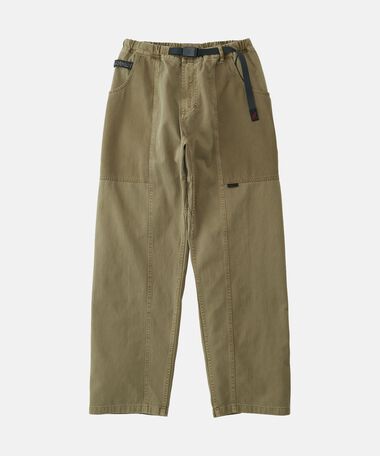
First and foremost, it started as a brand from climbing. I have always used their products while climbing, and I trust their functionality. What I particularly like is the rugged fabric. I’m not into synthetic fibers (laughs). Nylon can easily tear at the rock face, and if I wear tights underneath, I don’t perform at 100%, so I generally prefer to wear something thick made of cotton or hemp alone. In that sense, Gramicci's pants are quite handy.


――― Could you share how you came to operate the climbing gym "LOKU BOKU" in Hokuto City, Yamanashi Prefecture?
Due to my work, I travel around the country and have found several favorite places. Among them, this place is where I wanted to live even without climbing and I moved here five years ago. I had a vague desire to create a community based on climbing, and through various connections, I started operating " LOKU BOKU", utilizing the gymnasium of the closed Takane North Elementary School.
――― What is the concept behind "LOKU BOKU"?
In terms of interior design, I focused on creating a space in harmony with nature as if being in a forest. All the wood used comes from Hokuto City, including species like oak, chestnut, and ginkgo. Regarding climbing, I aimed to coexist comfort and climbing quality. When considering climbing alone, it’s important to secure enough climbable areas, but I believe it’s okay not to climb here. It's quite alright if someone just feels that it’s a comfy place to be.
This mindset also connects with my desire to avoid competition. Therefore, while typical gyms have grades and ranks, I’ve removed those as much as possible, establishing a wall where climbers can arrange their challenges themselves. While competitive rankings are part of the routes set by me and others, the core of that isn't necessarily what’s amusing, right? I want to foster a thought process that reflects on oneself instead of relying on outside comparisons. If climbers retain that mindset, their lives will become more enjoyable, in my opinion. Ultimately, I want them to venture into outdoor climbing as well. Climbing is a sport that can be pursued for a lifetime.


――― Do you have any future goals?
I would like to create climbing walls in gyms around the world. There was a time when I considered obtaining an international route setter license, but I ended up giving up because it was hard to balance that with wall creation. Hence, this time I plan to challenge the world with my originality, creating convex walls.
――― Lastly, what does climbing mean to you?
It’s an endless journey, I suppose. I feel as though I’m still walking the path of the initial dream I saw back then.

Photo: Kanta Nakamura (NewColor inc)
PICKUP ITEMS
 New
New