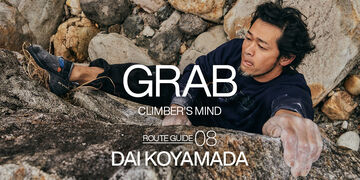
Gramicci is now a fashion fixture in everyday life, but its roots are clearly in climbing. The brand originated from the climbing pants of legendary rock climber Mike Graham, who was dubbed the "Stone Master" in the 1970s. In this series of articles, we will explore the mentality and lifestyle of climbers who have been captivated by the sport, and how they approach climbing. The signpost that traces the origin of Gramicci once again embodies the essence of surviving in the present.


NAME
DAI KOYAMADA
TITLE
Professional Free Climber
AREA
Hinokage Area
PROFILE
Born in 1976 in Kagoshima Prefecture. A key figure in Japanese climbing history, he has completed some of the most challenging routes worldwide and continues to make his name known globally. Currently, he is dedicated to developing unknown climbing areas throughout Japan. Even on his days off, he spends time searching for new rocks, making him a true, top-notch climber.

It is not an exaggeration to say that "Dai Koyamada = Japanese climbing history," s his contributions to the climbing world are so great. Even if he claims, "I just love climbing, not for anyone else," his achievements remain significant. To hear the voice of this living legend, who has dedicated his life to climbing, we headed to the Hinokage area in Miyazaki Prefecture, where he is currently working on development.


―――Could you start by telling us what motivated you to begin climbing?
I was born and raised in Kagoshima, surrounded by mountains, and naturally loved to play in nature from a young age. Around the age of 15, I started rock climbing as an extension of this interest and quickly became obsessed. I used to ride my bike to nearby mountains after school, and once I got a scooter in high school, I would venture all the way to Kumamoto with a guidebook in hand.
―――So you learned on your own rather than being taught by someone?
At that time, climbing itself was a minor sport, so I learned by climbing various rocks by myself. Fortunately, I enjoyed being alone, so perhaps climbing was a good fit for me. I felt like the rocks taught me a lot during those pure times alone with the rocks.
―――Did you go abroad immediately after graduating from high school?
I went to Europe for a year with the sole purpose of climbing rocks. By then, I had already decided to make a living through climbing. The first three months were spent in Aix-en-Provence in southern France. At the time, the climbing world was at its peak in France, andmy idol, climber Yuji Hirayama, also lived there. Although I couldn't meet him then, I returned to Japan and won the national championship in Ariake, defeating Hirayama(laughs). When I finally spoke with him, he seemed to have known that I had climbed some pretty difficult walls in France, which made me very happy.


―――“Can you tell us why you decided to stop competing at the age of 24 and pursue the path of being the first professional free climber in Japan?”
At the time, the only way to become a professional was through competitions. However, I had always felt uncomfortable while climbing on artificial walls, having started out loving natural rock. Around 2000, climbers like Fred Nicole started working only on outdoor rock, and I thought maybe I could do the same. After I made that decision, I focused on completing second ascents of famous routes around the world. This garnered major attention in the climbing community, and my name gradually became known.
Nowadays, there are many ways to make a living in climbing—working at gyms, route setting, etc.—but back then, the only way was to stand out at the crags. As a result, I became Japan’s first professional free climber.


―――“I’m sure you’ve completed countless difficult routes. Can you tell us about a memorable one?”
The first thing that comes to mind is Germany's "Action Direct," which was the most difficult problem at the time. It was a route that was first established by Wolfgang Güllich, the superhero of climbing, in 1991, and I admired him greatly. He passed away the following year, and I even visited his grave—he's one of my favourite climbers.
Being able to climb this route, which had been a dream and goal since I started climbing, was significant for me.
―――“I'm sure you have countless memories beyond that.”
Honestly, I don't have the luxury to look back much; I’m more focused on what comes next. I think I’ll reserve reflecting for later in life.


―――“Could you share your experience with Gramicci?”
I think it was when I was about 17 years old. The first pair of climbing pants I bought were actually Gramicci. I think they were a unique green colour. In fact, all my climbing friends around me were wearing Gramicci pants.
―――“That’s an honor. How did it feel wearing them again after a while?”
It had been a while since I'd climbed in cotton pants, but they were easy to move in. Normally when I go climbing, I choose synthetic fibers that are as light as possible. I even weigh them on a scale and pay close attention to the weight, down to 1g.
―――“That’s incredibly strict. ”
I wish Gramicci would create some genuinely effective climbing pants. The style is already proven, so if they added lightness and technical features, plus a dedicated climbing line, it would strengthen the brand image. I’m looking forward to that.


―――“What is your main activity now? ”
My current climbing style focuses on developing new areas. Simply put, I explore mountains, climb, and publish them as new climbing areas. I've been doing this for about 10 years now, and it all started with me wanting to leave behind my own creations.
By establishing first ascents, I can carve my name into the history of climbing. Making a first ascent is a very special act for a climber. Creating something from scratch instead of following others is a special act for climbers. I’m driven by the desire to create memories rather than just records.
―――“What’s the process of developing an area?”
First, you need to get permission from the mountain owner to use the rock. After that, a lot of work goes into building paths, cleaning the rocks, and clearing trees—it's almost civil engineering rather than just climbing. After that, a lot of work goes into building paths, cleaning the rocks, and clearing trees—it's almost civil engineering rather than just climbing.
―――“That sounds challenging. You are currently developing the Hinokage area in Miyazaki, right?”
The Hinokage area is originally a public rock climbing area, managed by Mr. Kiyokawa from the Kumamoto climbing gym "The Lunch. " I started by talking to him.
What's interesting is that there’s a local bouldering support group formed by non-climbers who want to revitalize the community through bouldering. We are working together on the development there.

―――“What’s attractive about the Hinokage area?”
The location is fantastic, and despite having around 1,000 established routes, many undiscovered rocks still have great potential. have been working there for about three years and have established around 20 routes so far. We're also concurrently working on a guidebook for the Hinokage area expected to be published this fall.
―――“I’m curious about the highlights of the development process.”
The most exciting thing is when I find an amazing rock while walking around the mountains.It's like I've found a treasure! It shouldn’t be too easy or too difficult, ideally straddling the line of limits.。
―――“So it's more exciting when you find the rock than when you climb it?”
Once I climb it, I feel a bit sad, like I wish I could stay longer. When I haven’t climbed it yet, I can keep coming back.


―――“What are your thoughts on the future of the climbing community?”
To be honest, basically I just want to be able to keep climbing. However, as a by-product of the areas I develop, it actually helps revitalize the towns, and that’s rewarding. It’s heartwarming when local people, who may not know anything about climbing, are happy to see visitors coming to their town.
As for the climbing world or younger climbers—I don’t really think about that. I’m terrible at mentoring (laughs).
“(laughs) But just showing them your example is enough, I think. What about your personal goals?”
As long as my body allows, I will keep developing areas. As for rock climbing, if I were to go overseas, I would like to go to Switzerland, but actually, just walking around the mountains here in Miyazaki, I can encounter so many fascinating rocks, so I think Japan is enough, or rather, it would be good to explore Japan further.
―――“Lastly, what does climbing mean to you?”
Exactly what the word says: climbing rocks. Nothing more, nothing less.


Photo:Tetsuo Kashiwada(NewColor inc)
PICKUP ITEMS
 New
New
 New
New