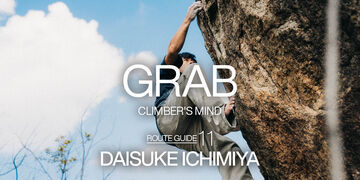
Gramicci is now a fashion fixture in everyday life, but its roots are clearly in climbing. The brand originated from the climbing pants of legendary rock climber Mike Graham, who was dubbed the "Stone Master" in the 1970s. In this series of articles, we will explore the mentality and lifestyle of climbers who have been captivated by the sport, and how they approach climbing. The signpost that traces the origin of Gramicci once again embodies the essence of surviving in the present.


NAME
DAISUKE ICHIMIYA
TITLE
Professional Rock Climber
AREA
Kitayama Park
PROFILE
Born in 1993 in Oita Prefecture. He started climbing in high school after joining the mountaineering club. He has built numerous achievements in both competitions and outdoor climbing, and now lives as a professional rock climber, constantly facing the rock. A LOVE & PEACE climber who passionately loves hemp.

When we met at Kitayama Park in Nishinomiya, Hyogo Prefecture, Ichimiya—who had previously been known for his dreadlocks—had switched to a clean short hairstyle. Greeting us with a bright smile and a friendly “Nice to meet you,” his warm personality was immediately clear. As a climber who ventures into unexplored areas in search of new rock faces, what kind of climbing philosophy is he pursuing?


――― What made you start climbing?
I grew up in Taketa City in Oita Prefecture, a countryside rich in nature. As a child, climbing trees and exploring mountains was just part of everyday play—like a natural playground. In middle school, I played baseball, but in my third year, I was invited by a senior who was one year above me and had joined the mountaineering club at Taketa High School, which was known as a strong team.
――― So the invitation from your senior was the trigger. Was Taketa High School’s mountain club mainly sport climbing?
Right when I joined, the club had just transitioned into sport climbing. Before that, it mainly focused on mountaineering. But in the year I was in middle school—when Oita National Athletic Games (Kokutai) were held—the venue was Taketa High School, and afterward the lead walls and bouldering walls remained.
――― What perfect timing. Do you remember your first time climbing?
Very clearly (laughs). On about my second day after entering Taketa High School, I visited the club in my uniform. Even though I hadn’t joined yet, a senior said, “Want to try climbing?” I started climbing without knowing right from left, and I hit a wall with a steep overhang. My legs dangled—like, “What do I do now?” I was hesitating, but when I looked up, the finish was right there, so I just reached up and slapped the hold—bang! Then the senior made this face—“Eh?!” (laughs). Basically, I had done a campus move, climbing with just my hands.
――― (Laughs). Like a “major newcomer incoming!” moment.
I guess so. It felt amazing, and that moment is still vividly etched in my memory.


――― And then you got really hooked and started training every day, right?
I climbed every single day. About six months after joining, I entered a selection competition for the National Sports Festival team—and thanks to all the practice, I actually won.
―――That’s impressive. After that, you went on to university in Kansai—was there a special reason?
At the time, I hadn’t planned to make climbing my career. My parents wanted me to become a civil servant, so I enrolled in Osaka Sangyo University to study economics with a focus on civil service.

――― I see. But you kept climbing during university, didn’t you?
Yes. The Oita Prefecture Mountaineering Federation supported training fees for a gym by providing a “strengthened athlete” slot, so I trained at the gym. Then that led me to work at a gym called “Galeera” in Taisho Ward, Osaka. And I basically fade out of university after that (laughs).
――― Tell me more (laughs).
When I came to Osaka, meeting all kinds of people at the gym broadened my perspective. There were so many people who made it feel not at all unnatural that I could live by climbing (laughs). I even asked a gym customer for advice, and he told me, “If you’re going to do it, you should quit right now” (laughs). I only went to university about ten times, and I quit. My first year was when it happened. After that, I made a living by working part-time at the gym and doing route-setting work.
――― When you quit university, were you already decided to live by climbing?
Not completely. Civil service exams can be taken until around age 30, so I thought I could try for about 10 years. If it didn’t work out, I could always go back.
―――When did you shift from competitions to outdoor crag climbing as your main focus?
Maybe around age 23. With competitions, it’s always you against someone else. But with outdoor climbing, the way you face it and how you use your time is freer. That suited me better.


――― Tell me about Kitayama Park’s characteristics.
It’s classic—pure classic. It was developed in the 1980s as one of the holy places where bouldering started in Japan. But it’s granite—slab, vertical, and steep walls—and there aren’t many dynamic moves, so the climbing can feel kind of quiet or “dull,” and modern climbers might not like that.
I’m actually bad at that style, so I intentionally visit during summers when the condition is worse to overcome it. Also, since its official name is Kitayama Greenery Park, there’s full of nature, and just walking here feels great.
――― I can see it. Even the route to reach the crag sounds like it’s not stressful at all—you can enjoy all the plants along the way.
Right. You should not copy this (embarrassed laugh), but I once climbed here at night because I didn’t know you shouldn’t enter after dark. From there you can see the night view—everything was incredibly beautiful (laughs).


――― When did you first meet Gramicci?
It was maybe about ten years ago. After moving to Kansai, I started seeing more outdoor brands. And many of the climbers around me were wearing Gramicci. Then, I started using it myself for climbing.
――― How does it feel to wear?
The fit is great, and above all, I like the durable fabric that won’t chafe when you sit on the rock. And I’m happy that it’s a design you can wear not only in nature, but also in the city.With the return of 90s fashion, maybe it’s also the right time for clothes that create that vibe.
――― Thanks. You also really like hemp material, don’t you?
Yes. In the past, there were a lot of hemp climbing pants. If Gramicci releases hemp products again, please let me know! I’ll buy them immediately (laughs).


――― I heard you’re known in the climbing community as “Bouldering Hunter.” What kind of activities do you do?
There are topographic maps published by Japan’s Ministry of Land, Infrastructure, Transport and Tourism with contour lines and such. So you look at those maps and, for example, if there’s a rock symbol along a valley, you go and aim for that area.
――― That’s seriously analog! So you’re basically searching for unknown crags?
That’s right. It started when I met people who climb using U.L. (ultralight) style, and I began about three or four years ago. I even put a sleeping bag in the same backpack I carried today, and I stay overnight—like one-night or two-day trips—sleeping near whatever crag I find.
―――That’s why your mat was thinner than a normal one. What’s the goal of boulder hunting?
We start from a hiking route, and along the way we find a rock area and climb there. Then we camp and live as part of the process, and the whole flow is something we can complete by ourselves—from start to finish. I like that there isn’t a fixed “goal” you have to reach; it’s more like a lifestyle cycle you want to keep doing. Overseas, people might walk for two days or so to find climbing spots, but in Japan it’s still rare. I hope this culture spreads.


―――You’re already 31 now. Are you going to live your life by climbing from here?
Yeah. Not just one foot in it—both feet are in (laughs). It’s like, I can’t really think of any other job. I’ll probably be climbing rock all the time.
―――Finally, if you have any goals for the future, what would they be?
I’d like more climbers to increase—people who can have fun with the same kind of atmosphere.
For example, not only climbing itself, but also enjoying the spaces around it—like making campfires during the trip, and the little in-between moments. Being a climber means facing rock and trying hard on difficult problems and finding enjoyment in that.
But I want to build more companions too—people who can laugh together before and after. That’s why I’ll keep doing boulder hunting.


Photo:Kanta Nakamura(NewColor inc)