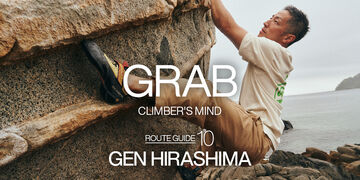
Gramicci is now a fashion fixture in everyday life, but its roots are clearly in climbing. The brand originated from the climbing pants of legendary rock climber Mike Graham, who was dubbed the "Stone Master" in the 1970s. In this series of articles, we will explore the mentality and lifestyle of climbers who have been captivated by the sport, and how they approach climbing. The signpost that traces the origin of Gramicci once again embodies the essence of surviving in the present.


NAME
GEN HIRASHIMA
TITLE
ROUTE SETTER
AREA
ITOSHIMA
PROFILE
Born in 1981. Raised in Kokura, Fukuoka Prefecture. A rare and leading Japanese route setter who holds not only the domestic route setter qualification issued by the JMSCA, but also the international route setter qualification issued by the IFSC. He has continued to work as a route setter for major competitions such as BJC, Sport Climbing at the Tokyo Olympics, and the IFSC Climbing World Cup.

Stepping out of a Dodge Ram Van whose presence has only grown stronger with age, Mr. Hirashima greeted us with a gentle smile and a soft, warm tone. I was instantly pulled in by the contrast. With the direct intuition born from this bold yet delicate duality, what summit is Hirashima striving toward?


――― First, could you tell us how you got into climbing?
The very first time I encountered it was in high school. I was riding a downhill bike and I used to go to an outdoor shop in my hometown. Then they installed a climbing wall there—that was my first exposure. When I look back, I was obsessively into it, climbing all day. But then that was it; I didn’t continue with it or anything.
――― I see. Were you deeply into anything else in high school?
In high school, I had to choose subjects—among things like calligraphy, music, and art. I chose calligraphy. I liked what my teacher wrote and the way he thought, and before I knew it, I got hooked. And because I wanted to go even deeper into calligraphy, I enrolled in a university in Niigata that had a course for calligraphy expression, with the aim of becoming a calligrapher.


――― So you were heading down a path that sounded far from climbing!
Up until my fourth year of university, I was constantly at school writing calligraphy, but gradually my goals became unclear… Then in my fifth year (laughs), a climbing gym opened in Niigata, and I started going. There wasn’t some “this is the reason” kind of trigger, but I started going and it just felt like this is it! It wasn’t even that I was looking for a reason; I just rediscovered that level of immersion. And once I got “the right sense” from that heat, I started running full speed. Then I thought it would be a waste to keep being at university, so I quit.
――― That’s a dramatic turn.
Climbing doesn’t give you any excuses. Whether you can do something or not is up to you. Of course there are other people who help, but you can evaluate yourself, too. With calligraphy, even if you are satisfied with it, you still have to be recognized by people with authority. So maybe I felt the comfort of climbing’s simplicity.


――― Itoshima is known for nature—sea and mountains—and many people relocate there. Are there good climbing spots too?
It’s not like it’s a famous major area for rock climbing, but there are plenty of rocks along the coast and in the mountains. I also do SUP, so I often visit with a kind of picnic mindset. I come about once every three months or so.
――― The location really is incredible. This crag is especially cool.
When I was about 23 and just getting seriously into climbing, I happened to see it in a magazine. There wasn’t much information back then, but I really wanted to climb itso I drove around the coast of Itoshima all night and finally found this memorable climbing spot. There aren’t many nearby parking spots and I don’t want to cause trouble, so I can’t reveal the name.
――― What do you think makes the crag special?
I like the simple structure of it—just me versus the rock. And I also enjoy the whole process—finding a rock you want to climb, figuring out the route, and then climbing it. The rock is always there and doesn’t change, which makes you aware of the changes within yourself.
――― Gyms are great, but there’s something you can only feel from climbing outdoors, right?
Yes. These days I do more relaxed climbing, but I want to do more aggressive climbing again sometime in my 40s. Since route setting helps maintain my climbing level, I want to find the right balance and continue developing and climbing crags I can truly engage with.


――― How did you first learn about Gramicci?
When I started climbing, my friend who was climbing with me would wear them. That’s how I came to know Gramicci. After that, I started wearing shorts more often.
――― How do Gramicci pants feel to wear?
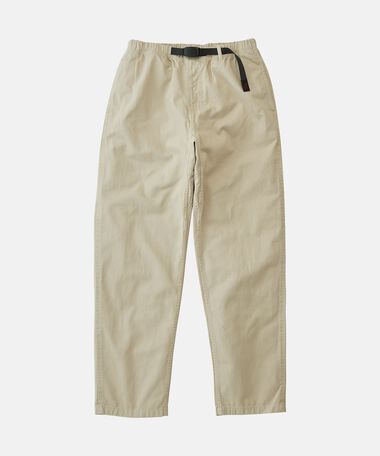
What I care about most is that there’s no discomfort. Gramicci pants are exactly that, and I also like the feel of the cotton twill fabric. I basically only wear natural materials like cotton and hemp. I don’t think I own a single synthetic T-shirt. The only exception might be swim trunks—(laughs).
――― I get that (laughs). Natural fibers are appealing.
And the non-restrictive silhouette is great. It’s not quite “relaxed” in the usual sense—but that nuance is important to me. With Gramicci pants, my movement isn’t interfered with. And I want to keep wearing them as everyday clothes, and really put them to use.


――― After competing as an athlete, what led you to become a route setter?
The person who inspired me was route setter Hiroshi Okano.I met him for the first time when he came to set routes for a competition in Niigata where I was competing as an athlete. When I told him I wanted to go to Tokyo, he introduced a climbing gym called T-WALL, and in 2007 I moved to Tokyo.
After that, I continued competing. But while I was climbing a problem, it suddenly occurred to me—“Wow, this problem is really well made.” It just popped into my head and became something I couldn’t ignore—(laughs). I’d done some route setting at gyms before, but that moment during a competition was what made me think I wanted to try route setting myself. I decided to close the chapter on competing and earned my domestic route setter license in 2010.
――― Did your long experience as a competitor become the foundation of how you set routes?
At first, I just created problems that I personally wanted to climb. But my thinking became much clearer through meeting people like Okano, Swiss route setter Manuel Hassler—known for creating problems that don’t let climbers succeed—and especially Tonde Katio, a French international route setter.
――― Could you tell us more about Tonde?
He was a key figure who brought European influence to Japanese climbing. Initially he came to Japan to create training problems for Japanese national team athletes. But then, once he set routes for the BJC, the scene in Japan changed dramatically.
In simple terms, climbing shifted from gripping with hands and feet, to where you climb holds in a more three-dimensional way—using your whole body. He is originally a designer, and he says that the process of design work and route setting are similar. He also compiled his independent learning into texts, and the route setter courses he ran around the world were very popular—he’s also excellent at teaching.

――― So you learned about the mindset of route setting from him.
Yes. One thing he often said was “LESS is MORE.” As few holds as possible—but make the movements as big as possible. That philosophy became the core of how I think.
――― That’s a profound phrase.
I think it means valuing space. When there’s just one object, people’s eyes focus on it. The question is how to create space and margins that encourage climbers’ imagination. When I keep that in mind, stepping back from the wall allows me to visualize climbers moving on the problems I’ve set. That made route setting much more interesting.
People say route setters are like directors and climbers are like actors—but it’s not about giving instructions. What I find rewarding is pushing climbers’ limits forward through the problems themselves.

――― You hold both domestic and international route setter qualifications. Was that difficult to achieve?
As I mentioned earlier, after obtaining my domestic route setter qualification in 2010, I wanted to take on the international route setter qualification—but the timing was bad. In 2011, the exam itself was cancelled, and the path was suddenly gone.
But I couldn’t just give up. I decided to do what I could, so I went to Australia for one year. I didn’t know anything about doing it abroad, and I wanted to try route setting in an environment I wasn’t familiar with. At first, I’d just walk into gyms and ask “Can I set routes here?” Eventually, I was allowed to set routes at different gyms, and in the end it became an extremely valuable experience.
After that, I asked a friend setter to have me included as a route setter at a European competition in 2015. There, I was recognized, and in 2016 I obtained my international license.
――― You really earned it through passion and action.
I believe the first people to obtain international licenses after 2011 were a female setter from Slovenia and myself, around the same time.
――― Are there differences in route setting approaches between Japan and overseas?
In short, Japan is precise, and overseas is bold. Japan focuses on the details, while overseas is more aware of how to express things as a whole. But now, with increased exchange among route setters, it feels like both strengths are being adopted by each other, and the differences are gradually disappearing when viewed globally.


――― What summit are you aiming for as a route setter?
Becoming the head route setter for the World Championships. It’s a position that only one person can do, and the event happens once every two years—so I’d really like to experience that.
――― We’re looking forward to it.
Thank you. If I could become head route setter and create problems that are meaningful for the athletes—and also routes I truly want to climb myself—that would be the best. That might be one kind of ultimate goal.


Photo: Tetsuo Kashiwada(NewColor inc)
PICKUP ITEMS
 New
New